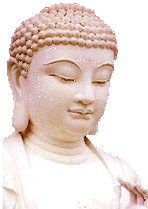
-
Speaking of
the twelve vows of the Medicine Buddha, we are referring to
the Buddha named Bhaisajyaguru, Lapis Lazuli Light King, and
the Sutra of the Original Vows and Merits of the Medicine
Buddha.
-
Shakyamuni
Buddha stated that in the ten directions of the world, there
are countless Buddhas and countless realms. But only two
Buddhas have a special connection with sentient beings in
the Saha world. These are Amitabha Buddha in the Western
world and the Medicine Buddha in the Eastern world.
-
We know about
the Medicine Buddha. When Shakyamuni Buddha came to Guangyan
City, he preached the Medicine Buddha Sutra in a pine
forest; the wind rustled the pines, and those with pure
minds perceived it as heavenly music. Guangyan City is
another name for Vaishali City, also where the Buddha
preached the Vimalakirti Sutra. This is a relatively
civilized, clean, and beautiful city where people and nature
live in harmony, a joyful and peaceful scene, unlike the
deadly scene of Rajagriha City. At that time, Manjushri
Bodhisattva asked the Buddha about the Pure Land of the
Buddhas, in other words, whether there was any other city
more beautiful than this one. The Buddha replied:
-
- From here,
heading east, ten billion Buddha-lands away, there is a
world called the Pure Lapis Lazuli World. The ruler of this
world is the Medicine Buddha, Lapis Lazuli Light King
Tathagata. While practicing the Bodhisattva path, he made
twelve vows to help all beings attain the best possible
material and spiritual lives.
-
The Buddha
introduced the Pure Lapis Lazuli World, which is very far
from us, ten billion worlds away, and is no less beautiful
than the Pure Land of Amitabha Buddha. Each world may have
different models and different decorations, because each
Buddha has different aspirations and vows. But no matter how
different they are, the Buddha-lands are all completely
beautiful.
-
It is
encouraging, and also important to know, that the two
Buddhas, Amitabha and Bhaisajyaguru, also originated from
human beings like us, also obscured by ignorance and
troubled by afflictions. However, they differ from us in
that they transformed human misconceptions into a completely
correct understanding and turned bad deeds into meritorious
ones. They also cultivated the three karmas of body, speech,
and mind to a state of complete purity, perfect clarity, and
accomplished many beneficial deeds for life. Such wonderful
achievements on the path of Bodhisattva practice are what
led to the Buddhahood of Amitabha and Bhaisajyaguru.
-
The
Bhaisajyaguru Buddha built the Pure Land of Lapis Lazuli
based on 12 vows, some of which are similar to the 48 vows
of Amitabha Buddha. These 12 vows are to apply to the social
circumstances and needs of people in the Saha world. Do you
remember that Shakyamuni Buddha, in the past, developed
Bodhicitta and practiced the Bodhisattva path? The
compassion of a Bodhisattva is immense, and the object of
that compassion is all suffering beings. Seeing the
suffering of beings evokes pity, but one's abilities are
limited; how can one save them? Therefore, Shakyamuni Buddha
also vowed to attain Supreme Enlightenment, meaning he would
have the full capacity to help before returning to save
sentient beings. The Medicine Buddha also made a similar
vow, and his twelve vows are very practical in life.
-
Today,
reciting the Sutra and chanting the name of the Medicine
Buddha is like taking medicine internally, externally, and
applying it topically. Internally, you are aware of each
delusive thought. Knowing the delusive thoughts, the
delusive thoughts dissipate. Whenever greed, anger, and
delusion arise, you know their root cause is wrong views.
You need to purify the six senses. Invoking the two words
"Medicine Buddha" is a reminder of your essential duty, to
be mindful and purify your mind with each thought.
Externally, you are confident in the Buddha's protective
power and vows. The Buddha is not far away; he is always
present in your moment. It is only because you chase after
worldly things, are easily stimulated, your thoughts change,
you are blinded by form, and the five aggregates obscure
your vision, making you seem distant from the Buddha. Now,
by chanting the name of the Medicine Buddha, you are not
deluded by delusive thoughts, free from the disease of
self-attachment, and not deceived by wrong views externally,
thus freeing yourself from attachment to doctrines.
Furthermore, you aspire to transform greed and anger into
boundless compassion. The path to liberation requires you to
be virtuous, have right views, and be well-versed in
learning, because even a hint of arrogance will make you a
friend of the devil. Furthermore, the sin of praising
oneself and criticizing others, slandering the true Dharma,
causes countless sentient beings to follow you into the
abyss of suffering. The diseases of jealousy, arrogance,
hatred, oppression, and all the sufferings of birth, old
age, sickness, and death, the Buddha vows to use his divine
power to liberate them from the karmic consequences of evil
deeds, gradually leading them to Supreme Enlightenment.
-
You recite the
sutra, daily cultivating a vast and compassionate mind,
hoping to enter the ocean of the great vows of the Medicine
Buddha. Practice living like him, with every thought wishing
to bring happiness and peace to those around you, no longer
fearing the suffering of evil deeds. From now on, vow to
bear the burden of all sentient beings, doing righteous
deeds that bring much benefit and peace. In this way, if the
forty-eight vows of Amitabha Buddha lead you to the holy
realm, the twelve vows of the Medicine Buddha will descend
to rescue you from the abyss of evil deeds, protect your
right view, and lead you to the victorious Dharma.
-
The Sutra of
the Merits of the Medicine Buddha's Original Vows consists
of seven parts. Master Hsuan-Tsang, seeking the Dharma in
India, requested and translated all of them into Chinese.
Because the Buddha Shakyamuni, out of compassion for
sentient beings afflicted by defilements and suffering,
revealed the existence of seven Medicine Buddhas in the
East. Each has their own vow, but the general purpose is to
cure afflictions, karmic obstacles, and karmic retribution,
enabling sentient beings to attain eternal peace, joy, and
health.
-
You already
know that each Bodhisattva, upon attaining Buddhahood, has a
world to teach all those with whom they have a karmic
connection. The seven Medicine Buddhas and their seven
worlds are:
-
1. Because of
their tranquil abiding, where wisdom easily develops, his
Buddha name is: Good Name Praise Auspicious King Tathagata,
residing in the Glorious World, four hundred billion Buddha
realms away from the Saha world. He is described as having a
golden body, with their left hand forming the Samadhi mudra
and their right hand forming the Fearless Giving mudra. He
helps sentient beings eliminate calamities and illnesses and
increase their lifespan.
-
2. Because of
their free contemplation of sound, his hearing is not
controlled or moved by sound. This is the Buddha-nature, a
priceless treasure that every sentient being possesses, yet
very few know about it. Therefore, the Buddha's title is the
Tathagata of the Precious Moon, Wisdom, and Glorious Light,
whose Pure Land is the Wonderful Treasure World, located
five hundred billion Buddha-lands away from the Saha world.
His entire body is golden-red, and his right hand forms the
Vow-Giving Mudra. He helps sentient beings to think clearly
and successfully in their endeavors.
-
3. Due to
perfect conduct, the Buddha's title is the Tathagata of the
Golden-Colored Precious Light, Wonderful Conduct, and
Accomplishment. His Pure Land is the World of Perfect
Fragrance, located six hundred billion Buddha-lands away
from the Saha world. His entire body is light yellow, and
both hands form the Dharma-Speaking Mudra. He helps protect
against calamities.
-
4. Due to a
mind free from worry, peaceful, and auspicious, the Buddha's
title is the Tathagata of the No Worries Supreme Auspicious
King, whose Pure Land is the World of No Worries, located
seven hundred billion Buddha-lands away from the Saha world.
His entire body is pink, and both hands form the
Equal-Holding Mudra. He helps bring good luck and success in
exams and studies.
-
5. Due to the
aspiration for enlightenment. This is the most supreme and
unparalleled state of mind, so the Buddha's name is Dharma
Ocean Thunder Sound Tathagata, whose Pure Land is Dharma
Assembly World, located eight hundred billion Buddha realms
away from the Saha world. He has a body of yellow or green,
with both hands forming the Dharma Teaching mudra. He
protects the peace and well-being of family members and
brings good fortune and wealth.
-
6. Due to the
joyful love of the Buddha's teachings and the pursuit of
Buddhahood, the Buddha's name is Dharma Ocean Victorious
Wisdom Playful Divine Power Tathagata, whose Pure Land is
Good Abode Treasure Ocean World, located nine hundred
billion Buddha realms away from the Saha world. He has a
body of reddish-brown, with his left hand forming the
Samadhi mudra and his right hand forming the Vow-Giving
mudra. He granted good health and a full and happy life.
-
7. Due to his
purity and solemnity, and his profound aspirations, the
Buddha is called the Medicine Buddha Lapis Lazuli Light King
Tathagata, whose Pure Land is the Pure Lapis Lazuli World,
located ten billion Buddha realms away from the Saha world.
His entire body is a sapphire blue color, his left hand
forms the Samadhi Mudra, his right hand forms the
Vow-Granting Mudra, and he holds an Alara fruit. He helps
bring about good fortune and fulfills wishes.
-
When you
venerate the seven Medicine Buddhas, do not forget the path
of the Medicine Buddha: to heal yourself and all sentient
beings. First, you must cultivate the Bodhi mind and seek
enlightenment. Then, find the means to cultivate thoroughly.
Just as you cultivate a field, you must choose good seeds.
Those who aspire to enlightenment must cultivate based on
their Buddha-nature. The conditions that help generate
wisdom are tranquility and the Buddha Dharma. With
sufficient causes and conditions, you will surely achieve
perfect enlightenment.
-
In truth, all
Buddhas and Bodhisattvas heal; they are all physicians. All
Buddhas and Bodhisattvas guide sentient beings to a state of
peace and happiness. But the reason you should face East to
pray for peace is that:
-
- Praying for
peace in the East symbolizes the rising sun, representing
life and activity.
-
And:
-
- Praying for
the deceased in the West symbolizes the setting sun,
representing annihilation.
-
In reality,
the Earth rotates, so there is no East or West. The sun
remains stationary; it doesn't rise or set. But clearly, in
our current lives, there is still East and West in space,
there is still the setting and rising of the sun, giving us
yesterday, today, and tomorrow. Time is illusory, but human
perception cannot do without a calendar to agree on days,
months, and years.
-
Because of its
adaptability, the Buddha, according to the cycle of birth
and death, arranged his teachings to include East and West,
so that sentient beings, in their turmoil, have a direction
to return to, to calm their minds, and gradually achieve
liberation. But in the Buddha's eyes, he saw in the infinite
space an infinite number of worlds of suffering, joy,
beauty, and ugliness. As the Buddha saw it, relative to our
Earth, the East has the Pure Land of Lapis Lazuli, and the
West has the Land of Ultimate Bliss. Those who study
Buddhism should carefully consider both the phenomenal and
the theoretical aspects.
-
Do not harbor
doubt in your heart, but boldly and directly strive towards
liberation without hindrance. Although the Medicine Buddha's
Vow Sutra has seven volumes, only one volume, that of the
Buddha Lapis Lazuli Light, has circulated in Vietnam because
Vietnam particularly venerates the Pure Land school. The
practice of reciting the Buddha's name is very popular. The
Medicine Buddha's Vow Sutra contains the following passage:
-
- If anyone
observes the eight precepts for at least three months and
hears the name of the Medicine Buddha Lapis Lazuli Light
King Buddha, then at the time of death, eight great
Bodhisattvas will guide them to the Pure Land world amidst a
multitude of beautiful, colorful flowers.
-
The entire Vow
Sutra strongly encourages you to recite the Buddha's name.
Therefore, the Medicine Buddha's Vow Sutra is considered a
practice of the Pure Land school, reciting the Buddha's name
to seek rebirth in the Eastern Pure Land. The following are
the Twelve Vows of the Medicine Buddha:
-
1. The first
vow: The Medicine Buddha vowed to attain Supreme
Enlightenment, which is the ultimate wisdom to help all
people overcome suffering, attain peace and happiness, and
to know how to serve others.
-
He knew that
all of you can bring peace and happiness to yourselves and
others, but due to a lack of wisdom, being obscured by
ignorance, you cannot achieve liberation or do beneficial
things for the world. In the time of the Medicine Buddha, he
already knew the immeasurable benefits of wisdom. And in
modern times, the age of scientific civilization, human
wisdom has been highly developed, creating many good
conveniences for human life. However, humankind develops
wisdom without the guidance of compassion, without directing
it towards serving humanity in a good way, but instead
causes much suffering to itself and to all living beings. A
prime example is the millions of people who died from bombs
and bullets in World War I and World War II. Therefore,
human wisdom must be accompanied by compassion to serve the
benefit of humanity.
-
In building
the Pure Land of Lapis Lazuli, the Medicine Buddha vowed to
develop the highest level of understanding to serve the
people there so that they may enjoy the happiest lives. This
is the model of a civilized world of Buddhism, based solely
on love and building maximum happiness for its people; in
that Pure Land, there is no evil, danger, murder, hunger,
disease, suffering, etc. Unlike the civilized world of
humankind today, which often destroys the lives of humans
and other sentient beings, as well as causing countless
terrible diseases, creating endless risks and dangers.
-
To save sentient beings, a Bodhisattva must possess the
highest wisdom to utilize resources in space and beneath the
earth to serve humanity without harming other species or the
life of the Earth. And the Medicine Buddha has achieved that
goal. He transforms difficulties into the best amenities of
a pure, beautiful, and joyful world, like the Pure Land.
-
By reciting
the Medicine Buddha Sutra, chanting the name of the Medicine
Buddha, and contemplating the first vow of the Medicine
Buddha, you must strive to elevate your understanding to a
higher level. Suppose you are reborn there to learn,
practice, and build a civilized world like the Medicine
Buddha, not for enjoyment. Indeed, the Pure Land of the
Medicine Buddha has Bodhisattvas such as Sunlight,
Moonlight, Medicine King, Medicine Supreme, Treasure Altar
Flower, and many other great Bodhisattvas. They are masters
with extraordinary wisdom for you to learn from. Certainly,
building such Pure Lands is not beyond your reach.
-
2. The second
vow of the Medicine Buddha is to have a body like lapis
lazuli, pure and radiant inside and out, radiating light in
all ten directions, so that all sentient beings who see it
will find peace.
- People in
this world develop wisdom, but their hearts are wicked and
their bodies impure, thus creating suffering for one
another. In reality, the more intelligent people become, the
more suffering they inflict on others. In the past, people
fought with their hands, then with stones, then with swords
and spears, and finally with guns and bullets, weapons of
mass destruction and murder. Civilization, coupled with
greed and wickedness, has caused immeasurable harm to both
humanity and all living beings.
-
The second vow
of the Medicine Buddha is excellent. The body and mind of
the Medicine Buddha are completely pure; therefore, when
reading the second vow, you should examine your own body and
mind to see if they have any blemishes, so that you can
begin to adjust and correct them.
-
A pure mind is
free from afflictions, karmic obstacles, and worldly
defilements. These three things are considered blemishes.
And of course, those who see your flaws will criticize you.
In spiritual practice, accept the criticism of others; don't
be angry or upset. Instead, be grateful to them, because you
cannot see your own faults. They dislike and disrespect you
because your words are not pleasant or comforting, typical
of negative speech. Negative speech creates language that
people don't accept. As for physical karma, because you have
committed many sins, your body is foul, ugly, and diseased.
Therefore, in spiritual practice, you transform the negative
karma of your body into a body of merit by using it to serve
sentient beings or society.
-
Many people,
although not beautiful in appearance, know how to practice
and serve others; this is using merit to adorn the body, so
they are also loved by many. Receiving affection from others
through doing good deeds is using merit to adorn the body.
People think of you or see you because they see your good
deeds. If your practice lacks dignity, how can people love
you? You must use merit to adorn yourself like the Medicine
Buddha. Regarding outward appearances, the most obvious is
that you should focus on serving others and not causing
trouble, so that others will think you are good and caring.
-
By reading the
Medicine Buddha Sutra and reciting the Medicine Buddha's
name, you must purify your body and ask others to point out
any flaws. When you have a pure body, it means no one will
criticize you. You do nothing that benefits others, but you
also don't bother anyone.
-
Following the
Medicine Buddha's vow to cultivate, you transform your body
to be pure, using virtuous precepts to adorn your body so
that others cannot criticize it. Furthermore, doing many
beneficial things for the world, inspiring others to develop
compassion, is already a partial manifestation of the
Medicine Buddha's vow.
-
Alongside a
pure body, deep within your mind, you must also recognize
the arising of deluded thoughts or the state of mind that is
tranquil. You must keep your mind tranquil. You recite
sutras, pay homage to the Buddha, walk in meditation, eat,
etc. Reciting sutras is about focusing your mind, following
the Buddha's teachings, and reflecting on how the Medicine
Buddha's vows led to his enlightenment. The Buddha
Shakyamuni spoke of the actions of the Medicine Buddha to
remind you to follow his example. In other words, the
Sakỳabuddha presented the Medicine Buddha as a model to
teach you the Bodhisattva path, to purify yourself, so that
in the future you too may attain the same state as the
Medicine Buddha.
-
3. The third
vow of the Medicine Buddha is to utilize skillful means.
Intelligence and virtue alone are fine, but without skillful
means, nothing can be accomplished.
-
Therefore,
Shakyamuni Buddha affirmed that because sentient beings have
many karmic obstacles, He offered many Dharma methods as
means of practice to resolve them. Today, practicing the
Bodhisattva path in this world, your object is sentient
beings, sentient beings' karma, and sentient beings'
afflictions. By reciting the Medicine Buddha's name,
remembering His third vow, you should also strive to find
the best way to resolve sentient beings, their karma, and
their afflictions. If you cannot resolve these three things,
you should not allow them to harm your own mind.
-
4- Fourth vow:
If someone follows a false path, the Medicine Buddha will
lead them back to the true path. If they follow the Two
Vehicles, He will lead them to seek Supreme Enlightenment.
There is a common saying:
-
- The Buddha
is one foot tall, the demon is one fathom tall.
-
Therefore, to
transform others, one must have the ability, prestige, and
spiritual power to convert them to the true path. In India
during the time of the Buddha, there were 93 religions, many
of which were very wicked. If one lacked sufficient prestige
and spiritual power to speak out, they would be killed. In
the past, Shakyamuni Buddha was able to convert those
practicing false doctrines and superstitious people because
he possessed the first three vows, just like the Medicine
Buddha. Today, there are also many false doctrines. These
false doctrines commit wrongdoings and intimidate people.
The Medicine Buddha clearly saw that when practicing the
Bodhisattva path, they were not listened to and were even
killed. Therefore, he vowed that after becoming a Buddha, he
would teach these wicked people. For those who followed
false doctrines, he would guide them back to the true path.
-
Those
practicing the Two Vehicles, or the Shravakas (disciples),
only receive alms and then practice for themselves.
Pratyekabuddhas focus on developing their own understanding.
Living in society, if everyone only cares about themselves,
it easily creates conflict. Seeing this, the Medicine Buddha
vowed to transform the selfish hearts of people into
altruistic hearts, that is, to seek Supreme Enlightenment.
Cultivating Bodhicitta means recognizing the immeasurable
benefits of a holistic and harmonious life, characterized by
selflessness and altruism, and promoting all actions towards
the harmonious integration and mutual enhancement. However,
to achieve such a common goal, you must first cultivate the
most correct understanding, the most noble life, and the
most complete means, before others will follow. In other
words, you must achieve the first three things, like the
Medicine Buddha, supreme wisdom, a body like lapis lazuli,
and sufficient skillful means, before you can accomplish the
fourth: transforming heretics and the Two Vehicles.
-
When reciting
the Medicine Buddha Sutra and reflecting on his fourth vow,
you should abandon selfishness to live harmoniously with the
masses, cultivating selflessness and altruism on the path to
Supreme Enlightenment.
-
5. The fifth
vow: Help those who lack precepts to attain them. Help those
who have violated precepts to return to pure conduct,
preventing them from falling into evil paths.
-
Before
becoming a Buddha, you may have good times and bad times.
But if you are not good, you will violate them and fall into
the three evil paths. For example, someone who makes
offerings and gives alms for a period of time, but then
develops evil thoughts, means their mind has changed. At the
very least, they lose their Bodhi mind, abandoning altruism
and living selfishly; but even worse consequences include
physical illness, mental distress, and increasingly
difficult living conditions.
-
When one loses
their mind and makes such mistakes, they should ideally be
reborn in the evil realms. However, if you remember the
Medicine Buddha, who possesses extraordinary wisdom and
immeasurable merit in teaching and guiding, you can make
progress, and your body and mind can be purified.
-
6. The sixth
vow: The Medicine Buddha saw that in this world there were
many people with ugly appearances, despised and abandoned by
others because of deafness, blindness, speech impediments,
physical disabilities, leprosy, and madness.
-
These people
suffer, and the more evil they become, the more likely they
are to be reborn in the three evil realms. The Medicine
Buddha thought of saving them because He has skillful means,
a way to help them escape suffering.
-
Speaking of
this vow of the Medicine Buddha, you should recall the
Buddha Shakyamuni's praise of the beneficial deeds of
Bodhisattvas. At that time, the monks told the Buddha that
since they had renounced the world and no longer possessed
wealth, what could they possibly do to cultivate the
Bodhisattva mind? The Buddha replied that he only feared
their own base minds; if they had the intention to help,
they could still do it. He said:
-
- If you find
someone of lower status to teach, they will still listen.
-
Each person
has their own strengths, and by utilizing those strengths,
anyone can do it. The Buddha taught the monks that when they
have plenty of food while begging, they can share it with
others, or even feed a few grains of rice to birds.
-
The Medicine Buddha has all the means to help and transform
the lives of those who are a burden to become those who
aspire to Supreme Enlightenment, those who are good people.
If one knows how to practice and live according to the
Buddha's teachings, one will gradually attain liberation.
-
By reciting the name of the Medicine Buddha, you follow His
good example and help those less fortunate than yourself.
Depending on your merit, reputation, and ability, you can
contribute to bringing happiness to those less fortunate,
and surely the Medicine Buddha will also guide you further
on this virtuous path.
-
7. The seventh vow: For those suffering from serious
illnesses and poverty, who cannot rely on anyone because
everyone shuns them, the Medicine Buddha will find ways to
help them escape their illness, achieve purity of body and
mind, and gain the love and closeness of others.
-
8. The eighth vow: For those born as women who suffer
greatly, the Medicine Buddha will also guide them in their
practice, transforming them into male bodies by changing
their female minds and karma.
-
A woman's mind is weak and needs care. Now, relying on the
Medicine Buddha, she strives to improve herself. Practical
experience shows that some women accomplish more important
things than men. Therefore, women need to change their weak
nature and strive to become more masculine. Transforming
into a man by developing intelligence, at the very least,
securing employment, and at the very least, holding
high-ranking leadership positions in society, such as
President, Minister, Chairman, etc., demonstrates superior
intelligence and blessings. Although possessing a female
body, the willpower of a man creates the necessary qualities
of a man.
-
Before practicing, women thought they needed to get married
to live, needed a life partner to rely on, and needed
sentimental feelings. But following the Medicine Buddha, a
woman who develops a charitable heart, helps others, knows
how to live independently, creates her own career with her
own hands and mind, knows how to create joy for herself in
life, knows how to rejoice in the joy of others, etc.
-
9. The ninth vow: If someone falls into the trap of evil,
bound by false doctrines, the Medicine Buddha will free them
so they no longer fear evil.
-
This is possible because the Medicine Buddha has greater
power than evil, so they fear Him, and He can persuade them
to abandon the evil path. He turns their hearts towards
Supreme Enlightenment, and by living in the righteous
Dharma, evil cannot harm them; this is called "evil cannot
touch righteousness."
-
10. The tenth vow: For those who have committed mistakes and
are imprisoned, the Medicine Buddha has a great vow to save
these ignorant people by bringing them to the Pure Land of
Lapis Lazuli. In this world, you will be surrounded by three
kinds of demons, unable to escape, especially the five
aggregates demon, which is the inner karma, the external
celestial demon that causes difficulties, and the demon of
afflictions that is hard to escape. Returning to the Pure
Land of Lapis Lazuli to cultivate, even without achieving
enlightenment, first and foremost, in His world, the mind is
at peace; only then can ignorance be dispelled; here, this
ignorance gives rise to other mistakes. Build the Pure Land
of Lapis Lazuli and educate its inhabitants to become good,
capable, and moral people. Reciting the Medicine Buddha
Sutra, you also follow His example, within your area of
expertise, guiding people to live and work in a good
direction so that they do not violate discipline, accomplish
their work, and have a peaceful life.
-
11- The eleventh vow: For those who seek food but create
evil karma, the Medicine Buddha provides them with
sufficient food and teaches the Buddha's teachings, enabling
them to attain Supreme Enlightenment.
-
According to venerable monks, vegetarianism does not involve
killing living beings. And go on, reduce your eating, eat
just enough to live on, even eat lightly, eat little;
because your material needs are not much, you can satisfy
them yourself and have surplus to give to the poor and
needy.
-
12. The twelfth vow: the poor and needy have no clothes to
wear.
-
The Medicine Buddha provides them not only with sufficient
necessities but also with plenty of beautiful clothes.
-
The last two vows related to food and clothing were
addressed by Shakyamuni Buddha for practitioners in the Saha
world with:
-
- Three constant inadequacies
-
Meaning:
-
- Eat and dress little, live a virtuous life, and do not
demand much material wealth.
-
But the Medicine Buddha said that in the Pure Land of Lapis
Lazuli, people can eat and dress comfortably.
-
In short, the Medicine Buddha clearly saw that people faced
many difficulties due to a lack of material possessions,
health, money, and wisdom, while also having an abundance of
diseases, poverty, ignorance, and accidents. Generally, they
possessed all sorts of evils, making it easy to commit sins
or hinder their progress on the Bodhisattva path. With
boundless compassion and immeasurable merit and wisdom, the
Medicine Buddha made twelve vows while practicing the
Bodhisattva path, leading to the creation of a Pure Land
called the Lapis Lazuli Pure Land, a world of complete
goodness. In his Eastern Pure Land, treasures are abundant,
excellent uplifting education, and the people live alongside
great, compassionate, and wise Bodhisattvas. Under the
guidance of the Medicine Buddha and his holy assembly, the
inhabitants of that world enjoy the best means to quickly
attain the state of Supreme Enlightenment.
-
To prepare for the Pure Land of Medicine Buddha, it is
suggested that you recite the Medicine Buddha Sutra, chant
the name of Medicine Buddha, contemplate his virtues, and
think of his pure world. You must certainly strive to
cultivate yourself according to the vows of Medicine Buddha.
These are the steps that will lead you to his Pure Land.