
|
|
DHARMA IN EVERYDAY LIFE
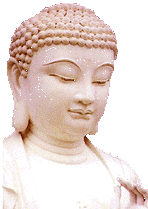
- SPRING FOR THOSE WHO
- PRACTICE SPIRITUAL
CULTIVATION
By Nhat Quan
-
---o0o---
-
Flowers bloom
and then wither, the moon waxes and wanes, events come and go,
time flows like water, and clouds drift by, like a fleeting
dream. But in that dream of life, those who practice spiritual
cultivation see the eternal in the impermanent. They see the
uncreated and undying within creation and destruction, thus
remaining calm and at ease in the face of their own birth and
death, as Zen Master Man Giac once said:
-
- Spring
departs, a hundred flowers wither
-
Spring
arrives, a hundred flowers bloom
-
The events
before our eyes pass by
-
Old age
approaches
-
Do not say
that when spring ends, all flowers wither
-
Last night, a
plum blossom bloomed in the courtyard.
-
The plum
blossom blooms eternally in the boundless land of the heart,
regardless of all the continuous transformations in the
ceaseless flow of time. All things are impermanent; the world
changes, the universe and humanity operate continuously in
every moment according to a cycle of reincarnation without
beginning or end. Spring comes, spring goes, and then spring
returns again. There is no first spring, nor is there a last
spring. In that continuous cycle of birth and death, there is
something that is neither born nor dies, a seed of life that
continues endlessly. This seed of life is latent in the vast
Dharma realm; in this world, everything arises from causes and
conditions, and what is formed by these conditions also
dissolves according to these conditions. But at the root of
these formations and dissolutions is a foundation that is
indestructible, unchanging, firm and eternal, vast and
encompassing all causes and conditions of birth and death.
Nevertheless, from the perspective of conventional truth,
spring symbolizes latent life full of energy. When a
practitioner realizes the uncreated and undying within
themselves, they see the true face of the Lord of Spring, and
that is also the eternal spring of Maitreya Buddha, full of
joy and hope for the future.
-
Indeed, in
terms of birth and death, the arrival of spring symbolizes the
renewal of nature after a long winter's sleep. The dry and
withered plants become beautiful and vibrant, bursting with
life in a multitude of colors. In this joyful spring
atmosphere, people are also filled with enthusiasm and hope
for a better new year. For centuries, visiting temples to pray
for peace and blessings in the first days of the lunar new
year has become an indispensable custom in Vietnamese culture.
Buddhism has become deeply ingrained in the hearts of the
people and in the cultural life of the nation, as reflected in
the poem by the late Venerable Man Giac:
-
- The temple
roof shelters the soul of the nation,
-
The way of
life of our ancestors for generations.
-
All of you
enjoy spring with blooming flowers and sprouting plants, and
all creatures turn towards the warmth of heaven and earth.
That is the spring of birth and death in the world. But for
Buddhist practitioners, seeing spring is different from how
ordinary people see it. Spring in the realm of spirituality,
or as people often say, spring in the realm of Zen. Because
when one finds a place of refuge for the soul, feeling peace
in a moment, or eternally, that is the spring of spirituality.
This kind of seeing, knowing, and awareness is considered the
spring in the realm of spirituality, or the spring of
awakening, of silence, without external activity, but
radiating brightly in the spiritual world; this is the beauty
of spring in the eyes of a Zen master. Next, leaving the
material world and delving into Zen, that is, standing from
the perspective of non-birth and non-death, or from the
perspective of non-existence, and looking down at the shore of
birth and death, you see all beings in birth and death and
also see your own body of birth and death within it. When you
see the operation of birth and death in this way, then the
spring of the practitioner begins to unfold. Thus, the world
of Spring unfolds under the condition that one who practices
spiritual cultivation in a realm of non-birth and non-death
looks down upon the world of birth and death. At that time,
you see that the world of birth and death, with its myriad
colors and forms, also possesses its own beauty, not just the
bleakness you perceived when you were still trapped in the
cycle of birth and death.
-
You are in a
house of fire of your own making, surrounded by a web of
ignorance formed by your own malice. Given this reality,
humanity certainly cannot experience true peace and happiness,
and naturally, you cannot feel the warmth of spring sunshine,
the fragrance of the earth and sky to soothe your soul's pain,
and true spring is not present in your every breath, even
though you are walking in the vibrant spring of the world.
-
- A spring
heart makes the universe spring-like,
-
A peaceful
heart makes the world peaceful everywhere.
-
This is the
timeless message of a peaceful and happy world that the Buddha
solemnly conveyed to all of humanity over 2569 years ago. This
has profound humanistic significance, forming a solid
foundation for building and establishing a lasting and stable
peace for humanity. To have a stable and peaceful society
where people can live in peace and happiness, the fundamental
solution remains the self-improvement of individuals. From the
perspective of Buddhism, the world is manifested as a
reflection of the human mind, such as:
-
- A person
full of compassion and joy, who respects and loves others,
will be respected and loved by others.
-
- A harmonious
family, united and loving each other, is a happy family.
-
- A country
where all citizens know how to unite, trust, and respect each
other, working together to build and protect community life,
that country will be prosperous, and its people will truly be
well-off and happy.
-
- A world
built on the spirit of dialogue, cooperation, understanding,
sharing, respect, and mutual protection, that world will have
no war or violence, no regional conflicts, and no power
struggles where the strong prevail over the weak.
-
The Buddha
Shakyamuni, a man of peace, laid the foundation for eternal
peace in humanity through cooperation, reconciliation, love,
and forgiveness. He deserves admiration and to be followed and
learned from. Through this, his message has been transmitted
to humanity:
-
- There are no
classes when people share the same red blood, and their tears
are equally salty...
-
Only love can
extinguish hatred.
-
Or:
-
- Counter
deceit with truthfulness.
-
Everyone fears
swords and spears; everyone wants to survive.
-
And:
-
-
Self-conquest is the greatest victory. Finally:
-
- It is not
your parents, relatives, or anyone else who makes you noble,
but your pure and virtuous heart that makes you nobler.
-
These timeless
teachings originate from the soul of the Master, whose
morality and wisdom are shining examples for humanity to
follow. These noble thoughts are like fresh flowers, sweet
with the fragrance of love, peace, and tranquility. They
uphold the spirit of equality and respect for the peace and
happiness of all people, as if it were our own peace and
happiness.
-
Life has too
much suffering, too much oppression, and disappointment. Each
person needs to do many beneficial things to sow seeds of
compassion and happiness in the soil of humanity. To adorn
life with even more fragrance of human kindness and truth. So
that you truly have an eternal spring, a spring of human
kindness that sees and shares with each other in all
circumstances. So that spring truly resides in people's
hearts, so that humanity can forever be happy in an endless
spring. Because there, a wonderfully joyful vitality arises
when looking at the beautiful scenery of Spring; everyone's
heart feels excited and joyful, welcoming a peaceful, happy,
and auspicious spring.
-
The fragrance
of spring makes people optimistic and love life; it is also a
time when those who cultivate their minds and character can
transform themselves, rise above past troubles, and look
towards a promising future. Every Buddhist disciple wishes for
immeasurable peace and happiness, auspiciousness in all
things, successful Buddhist endeavors, perfect attainment of
the Buddhist path, and an eternal spring, as expressed in the
meaningful blessings given each spring. To achieve these
meaningful blessings during the spring season, Buddhist
followers should clearly understand the doctrine of cause and
effect and practice the Dharma correctly, applying Buddhist
teachings in daily life.
-
The profound
importance of Buddhist teachings, manifested in the value of
the noble and righteous way of life of practitioners, is the
essence of spring in the beauty of those who practice,
resulting in peace, auspiciousness, and fulfillment, which are
always present even without seeking them.
-
Following in
the footsteps of the Buddha to learn the beautiful virtues of
compassion and wisdom, due to humanity's absolute admiration
for the truth that leads to liberation from birth and death,
His influence has been immeasurable throughout generations.
Therefore, for those who practice, the path of spiritual
practice is fraught with many difficulties and obstacles. At
the same time, there are many temptations of material wealth
and fame during the period of self-control. This is a test and
a training ground for cultivating the mind and character. As
each spring passes quickly, human life is truly short. The
pure and serene lifestyle of those who practice involves
restraining the six senses: eyes, ears, nose, tongue, body,
and mind.
-
- Eyes: Do not
perceive material things as eternal or precious, and do not
cling to them for oneself.
-
- Ears: Do not
listen excessively, do not be attached to praise or criticism,
and do not give rise to feelings of love, hatred, or
discrimination.
-
- Nose: Do not
let strange smells or tastes disturb the mind, and do not give
rise to infatuation or a desire for enjoyment.
-
- Tongue: Do
not let the sensations of deliciousness or unpleasantness, or
preferences, control you, and do not create unwholesome karma.
-
- Body: Do not
engage in competition, showing off beauty or ugliness, and do
not give rise to arrogance or rivalry.
-
- Mind: Do not
let the mind give rise to deluded thoughts, which will disturb
the consciousness and lead to sin.
-
The proof of
human liberation is living peacefully and serenely, with a
calm mind and clear wisdom, far from the hustle and bustle of
everyday life, far from the worldly pursuit of fame and
fortune, and escaping the ocean of suffering and
transmigration. That is when your mind is completely at peace.
-
The beauty of
a person who practices spiritual cultivation is not in unusual
external appearances, not in high hats, embroidered robes, or
colorful garments. For a person who practices spiritual
cultivation, spring is the pure beauty of the inner self, when
the mind is pure, free from greed, hatred, and delusion, with
a virtuous character, and a willingness to bring benefit to
oneself and others. Thus, if spring is the most beautiful
thing, then it must be the beauty of your soul. Being close to
virtuous people, you will feel immeasurable peace and
happiness, like enjoying the cool breeze and warm sunshine,
full of the spiritual essence of beautiful spring flowers, and
it is only beautiful when you know:
-
- Cultivating
the mind and observing precepts is beautiful in body.
-
- Respecting
superiors and being humble towards inferiors is beautiful in
character.
-
- Being humble
and gentle is beautiful in demeanor.
-
- Helping
others in times of trouble is beautiful in heart.
-
- Being filial
to parents and respecting virtuous sages is beautiful in the
soul.
-
- Meeting
those who are suffering and afraid, and offering words of
comfort, that is beautiful language.
-
- Not
harboring evil thoughts, always maintaining an upright heart,
that is a beautiful intention.
-
- Knowing how
to be magnanimous and forgiving – that is a beautiful virtue.
-
The mind and
conduct of a person who knows how to practice are always hướng
towards nobility, truthfulness, selflessness, and altruism,
and will surely attain boundless peace and Nirvana. That is
the spring in the beauty of a person who knows how to
practice, and also the value of endless happiness for the
practitioner in this world.
-
Buddhism does
not require everyone to completely sever all affection for
loved ones to be considered a true practitioner. The meaning
of the word "practice" is to cultivate the mind and refine
one's character. The Buddha taught:
-
- Conquering a
million armies is not equal to conquering oneself.
-
Conquering
one's own mind is the most glorious victory.
-
When all
deluded thoughts, desires, and perceptions are eliminated, you
will be able to control greed, hatred, and delusion. The
practical result, and also the reward for the continuous
efforts of the practitioner, is a series of happy, joyful, and
peaceful days. A weak person who fears difficulties, has a
selfish nature, likes to dream of fame and fortune, and
demands many material pleasures for themselves, will find it
difficult to practice at home. For example, parents who want
to practice at home, while also responsible for providing for
their family and children, and also supporting the Three
Jewels, studying Buddhist teachings, chanting Buddha's name,
meditating, reciting scriptures, and self-reflecting to purify
their minds, not everyone can do this. If one can perfectly
practice at home, the practitioner always sacrifices a great
deal for themselves; such noble intentions are difficult to
achieve and implement, but that is precisely the best
environment for cultivating the mind and refining one's
character.
-
Those who wish
to practice Buddhism can do so in any circumstance, if they
understand the way to practice according to the Buddha's
teachings. This means applying the four immeasurable minds:
loving-kindness, compassion, joy, and equanimity, being
tolerant and generous in their interactions, knowing how to
restrain themselves from material pleasures, and bravely
sacrificing personal interests. Those who practice at home can
not only cultivate themselves but also guide their family
members and serve as role models for their children and
grandchildren. By living contentedly, not demanding much, and
not being preoccupied with meaningless pleasures, those who
practice Buddhism will have ample time for studying scriptures
and cultivating wisdom and compassion.
-
The beauty of
a person who practices Buddhism lies in their authentic and
innocent life, a pure character, and a Bodhisattva mind free
from attachment and discrimination. Even if you don't have
the outward appearance of a monastic, you can still achieve
spiritual accomplishment. A person who practices Buddhism can
bring absolute peace of mind and immense comfort to themselves
and those around them through their conduct in every gesture,
word, action, and thought. This is the wonderful and subtle
meaning of spring in the beauty of a person who practices
Buddhism, starting from the simplest things in daily life.
This lies in the Bodhisattva's virtuous conduct, a dignified
character, and humble morality.
-
In this
beautiful spring, with a peaceful and serene mind, let those
who practice Buddhism return to their inner selves, light the
torch of wisdom, cultivate compassion, and see their own
unborn and undying Buddha-nature, to realize this subtle
meaning of spring. Only then can you live a tranquil life,
neither inferior nor superior, with a free and fearless
perspective amidst all things that exist and cease to exist,
right and wrong, gain and loss, honor and disgrace. In this
world, all phenomena that arise and cease are impermanent.
-
Spring, in the
beauty of a person who practices Buddhism, truly brings peace
of mind and body, dignified blessings and wisdom, fulfillment
of desires, and auspiciousness in all things. Because, as you
all know, no one but yourself is ultimately responsible for
your circumstances. The most practical value of Buddhism is
the law of cause and effect. Cause and effect may sound
simple, but their impact is immense. Cause and effect is a law
of the universe; as the cause is, so will the effect be.
Regardless of the individual, society, or organization,
whether you believe it or not, the law of cause and effect
silently operates according to its evolutionary process. Those
who practice Buddhism understand this law better than anyone
else. Buddhists understand that wealth and material
possessions obtained through compassion and the Bodhisattva
vow to benefit others are not only valuable for achieving
material prosperity but also bring joy and happiness to those
around them. Buddhists who practice the Dharma gather at the
beginning of the year to exchange greetings for a prosperous
new year. These greetings truly stem from applying the
principle of attracting circumstances with the mind.
-
Relationships
within the family and in society are no different. No one
likes to be around you if you only think of yourself and your
ego. No one likes to have a relationship with you if you are
dishonest and insincere; no one likes to communicate with you
if you are stubborn, always believing you are right without
respecting or considering the opinions of others. Due to
selfishness and stubbornness, your relationships gradually
break down and fall apart. All interactions become superficial
and forced. A suffering mind attracts suffering circumstances,
spreading suffering to society and the community. Conversely,
Buddhist teachings encourage you to practice generosity and
cultivate an open heart.
-
Giving alms
and making offerings with money is difficult, but giving with
an open and loving heart is even more challenging. As a
Buddhist practitioner, you should cultivate an open heart
every day, every hour, sharing joy and sorrow with all beings.
This requires practice; it's not something that can be
achieved in a day or an hour. But after successful practice,
the result will be peace, happiness, and contentment, without
the frustration and discomfort of unsatisfactory
circumstances. Naturally, relationships with family, friends,
and the wider community will become cherished and sincere,
exchanging affection and love in accordance with the Dharma of
liberation.
-
The mind is
the cause, and external appearances or circumstances are the
effect. The process from cause to effect goes through
conditions; conditions are what allow the effect to mature.
Because you understand cause and effect, you can also change
the process of cause and effect. As sentient beings, there
will inevitably be times when we lack wisdom and create
unwholesome karma. But the present and the future offer many
opportunities to change the conditions, that is, to change the
circumstances so that the cause does not develop into an
effect. However, you and only you must seize these
opportunities and strive to make changes. Because if you have
sown the seed of karma and continue to create the conditions
for it to ripen, and you don't make changes, then the
consequences will manifest, and at that point, complaining or
praying to overcome the karmic obstacles will be quite late.
-
Buddhists
often apply the law of cause and effect, so regardless of the
time of year, Spring, summer, autumn, winter, location, or
circumstances, good or bad, you remain calm and quietly adapt
to all situations to improve yourself. Once the current
circumstances change favorably towards liberation, the future
rewards will surely be happiness in the realm of liberation.
-
Those who
practice Buddhism understand that worldly concepts are
constantly changing and impermanent. Ideas about people or
life that were once considered true and accepted in one
context may no longer be valid in another. A typical example
is springtime in Southeast Asia, which falls around January
and February according to the lunar calendar, but during the
same period in the Southern Hemisphere, it's the end of summer
and the beginning of autumn. On one side of the ocean, trees
are lush and green, flowers are blooming to welcome the new
spring, while on the other side, yellow leaves cover the
ground, preparing to fall, waiting for winter to pass before
spring arrives. The true spring in Australia is around August
and September according to the Gregorian calendar, not January
and February as in Vietnam. Everyone knows that time changes
according to different geographical circumstances, just as
people's ingrained ways of thinking gradually change with each
stage of social evolution. Attachment to auspicious or
inauspicious times, and inhumane thoughts about gender, age,
or social class, have changed considerably today from the
perspective of true Buddhists.
-
Indeed, before
understanding Buddhist teachings, before understanding that
all sentient beings have Buddha-nature and the same potential
for enlightenment, the world often clings to limited ways of
thinking, binding itself to obstacles that lead to suffering
and distress. In the past, all areas of religion, politics,
and social management overlooked the position of women. But
today, reality proves that gender differences do not hinder
the ability to manage, develop science, or attain liberation
through spiritual practice. Gender, age, and social class,
these divides have gradually been bridged in a spirit of
respect and mutual affection. From there, it becomes easy to
connect through compassion and equality, in accordance with
the principle:
-
- The power of
the Dharma is inconceivable, compassion is without hindrance.
-
Those who know
how to practice do not passively accept their fate but strive
to change their circumstances. In Buddhism, this is called:
-
- Transforming
the ordinary into the sacred.
-
Even during
life, or even after death, one can relinquish the physical
body to attain the Dharma body, meaning praying that after
leaving this perishable physical body, one can attain the non-생멸
(non-birth and non-death) Dharma body along the path of
liberation. Clearly, this process of change and transformation
does not discriminate between class or gender. It goes even
further, to the point that whether alive or dead, Buddhists
are not hindered. While alive, there is the physical body for
practice and change; after death, only consciousness remains
without the physical body, yet there is still an opportunity
for transformation and liberation. As long as sentient beings
are willing to change for liberation.
-
Some say:
-
- Imprisoned
in a physical prison, one still hopes for a day of escape, but
once one has imprisoned oneself in a mental prison, it is
difficult to escape for eternity.
-
This is how
those who managed society in the past, who did not accept
humanistic values, deliberately created inhumane concepts to
manage society in their own selfish and narrow-minded way.
Buddhists are different; they always firmly believe that all
sentient beings have the same Buddha-nature and that
practicing the Dharma requires continuous diligence. You
should not limit yourself to feelings of inferiority,
accepting your circumstances, and allowing them to control you
without striving to improve.
-
Sincerely
exchanging best wishes at the beginning of the year is a
beautiful and precious tradition. The heart is important, but
it cannot be expressed without the means of language. Social
life, whether harmonious and peaceful or filled with quarrels
and conflicts, is largely due to language. However, language
must be spoken sincerely from the heart; otherwise, it becomes
clichés, insincere, meaningless, and, most importantly, fails
to touch the listener's heart. It would be truly regrettable
if what is said is not received by the listener.
-
Those who practice Buddhism diligently cultivate sincerity and
truthful speech every day. Sincere words always touch people's
hearts. Close friends who have cherished each other for
decades do so because of their sincere treatment of one
another. Even amidst conflicts and misunderstandings,
sincerity helps to mend relationships, and over time, that
bond of friendship grows even stronger. Today's society is
full of turmoil; modern communication seems to bring people
closer, yet they remain far apart. Perhaps the obstacle of
selfishness between people has not been overcome due to the
lack of sincerity. The beginning of Spring is the most
meaningful time for everyone to forget the disagreements of
the past year, rebuild relationships, and cultivate compassion
through sincere words, wishing each other a beautiful new
year.
-
In short, at the beginning of the year, everyone goes to the
temple to pray to Buddha for blessings, to witness the
blooming of countless flowers, the elegant beauty of nature,
and to receive blessings from everyone. There, everyone feels
an incredibly joyful and miraculous vitality, because when you
see the beautiful scenery of spring, everyone's heart feels
uplifted and joyful, welcoming a peaceful, happy, and
auspicious new year. The scent of spring makes people
optimistic and full of life; it is also a time when those who
cultivate their minds and character can transform themselves,
rise above past troubles, and look towards a promising future,
a simple promise, a simple wish:
-
- At the beginning of the year, Buddhists go to the temple
-
Meeting each other, wishing each other a lifetime of joy
-
At the beginning of the year, welcoming laughter
-
In the middle of the year, younger and healthier than in the
past ten years
-
At the end of the year, the year ends without aging
-
In the following year, leisurely enjoyed the spring.
---o0o---
If you have any recommendations,
please e-mail to:
chuaduocsu@duocsu.org
|
|